
State predicts cellular perturbation effects across diverse contexts with over 30% improved discrimination on large datasets.
- 6 cited this week
JClub reads the firehose — 104 journals and the preprint servers — and hands you the papers worth your attention: one card at a time, each with a four-part AI summary and a link to the source of record. Where your library is on LibKey, the full text is one tap away.

Free on iPhone and Android, and it works without an account.
New citations, press coverage and Bluesky conversation, measured nightly across every paper JClub indexes — with the app’s AI summary on each.
State predicts cellular perturbation effects across diverse contexts with over 30% improved discrimination on large datasets.
A biobank of 256 patient-derived tumour organoids reveals diverse gene dependencies across multiple cancer types, advancing precision oncology.
The 2026 AHA/ACC/ADA/ASN guideline updates and expands management strategies for cardiovascular-kidney-metabolic syndrome, targeting clinicians caring for affected patients.
A telomere-to-telomere human genome benchmark achieves 99.4% accuracy, adding 701.4 Mb of previously missing autosomal and sex chromosome sequences.
CD8+ T cell immunity enhances tumor cell susceptibility to cuproptosis, improving the effectiveness of inducers in overcoming immunotherapy resistance in preclinical models.
Keeping up is rarely a reading block you schedule. It’s a few minutes between the bench and the next meeting, working out whether anything published since you last looked is worth opening. JClub is built for that session, not for a seated hour.

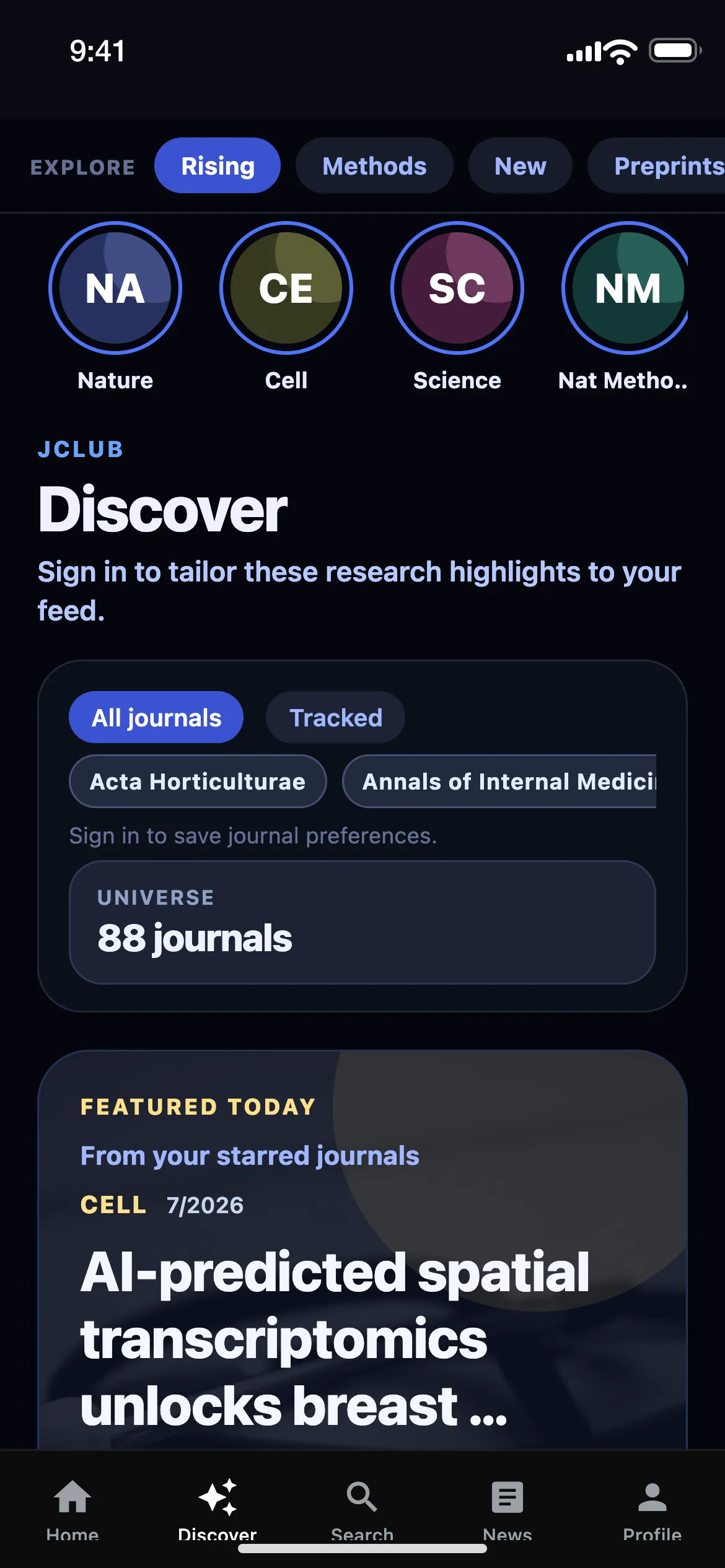
Pick from 104 titles across 10 fields — or start with three interests and let the ranking work from those.
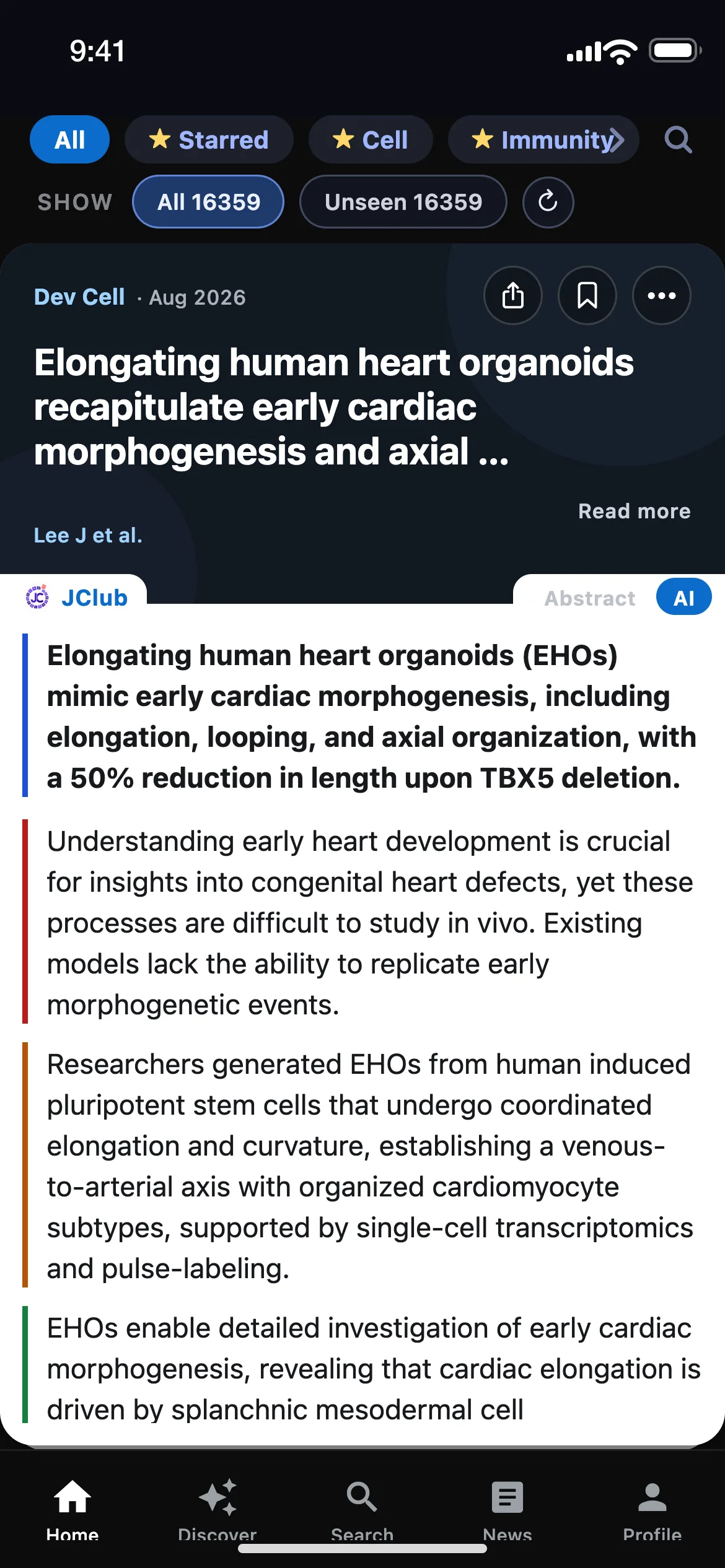
The newest papers arrive as focused cards, one at a time. Swipe up when you’re done — the deck remembers where you left off.
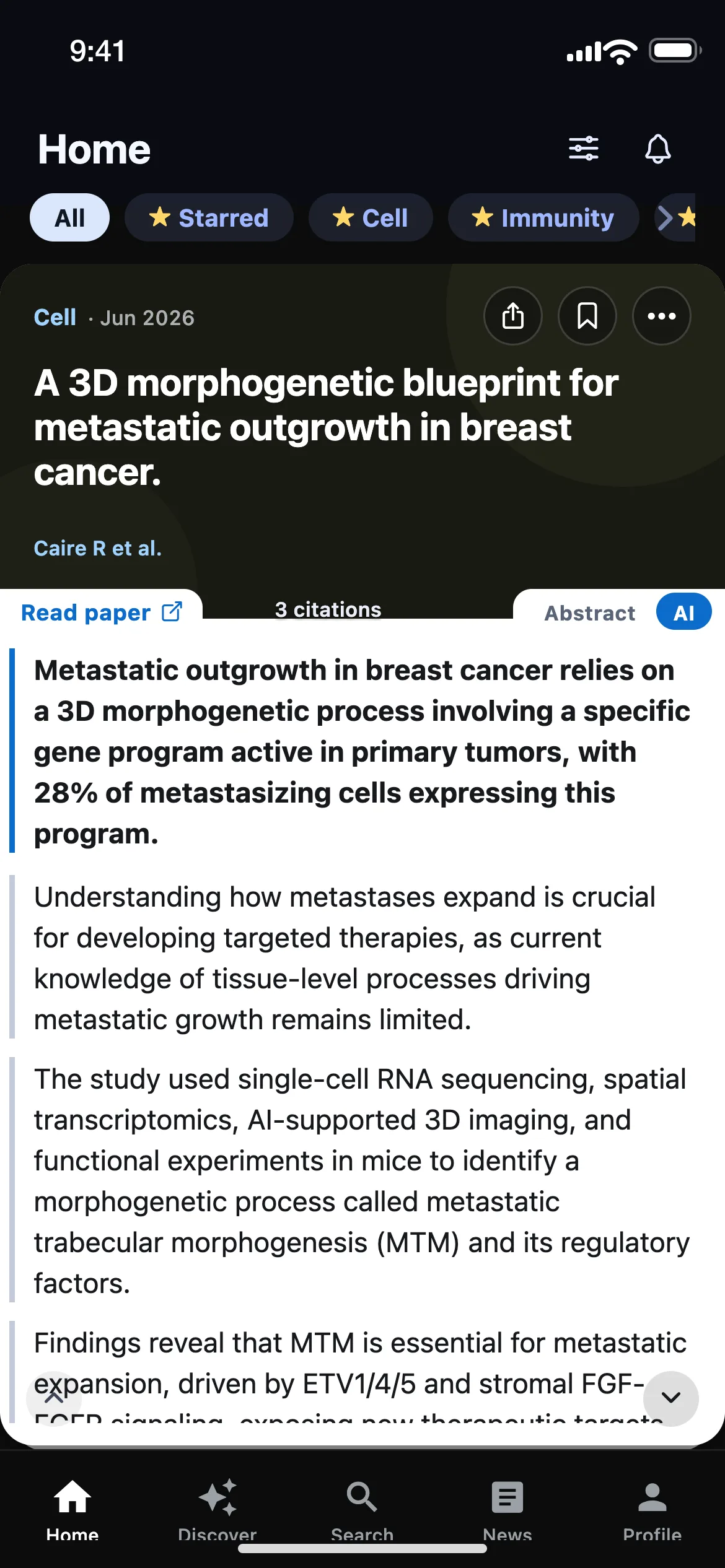
Lead with the four-part AI summary, read the abstract where its licence allows, or open the full text — through your own library where it holds the paper. Every card links to the source of record.
Follow authors and papers, set alert keywords, and get a push when a new paper cites your work.
No infinite scroll, no wall of tabs. Each new paper is a single card — swipe up when you’re done, and the deck remembers exactly where you left off.
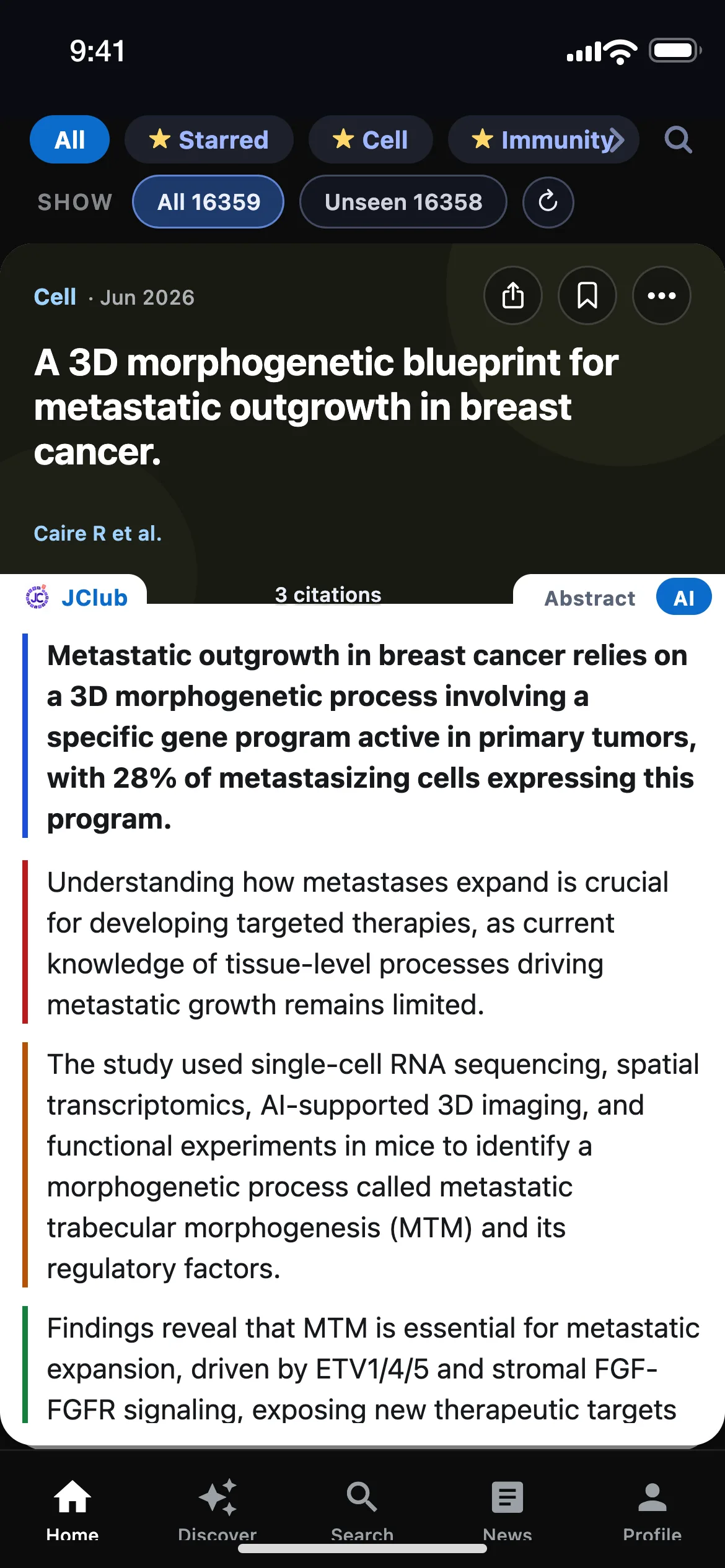
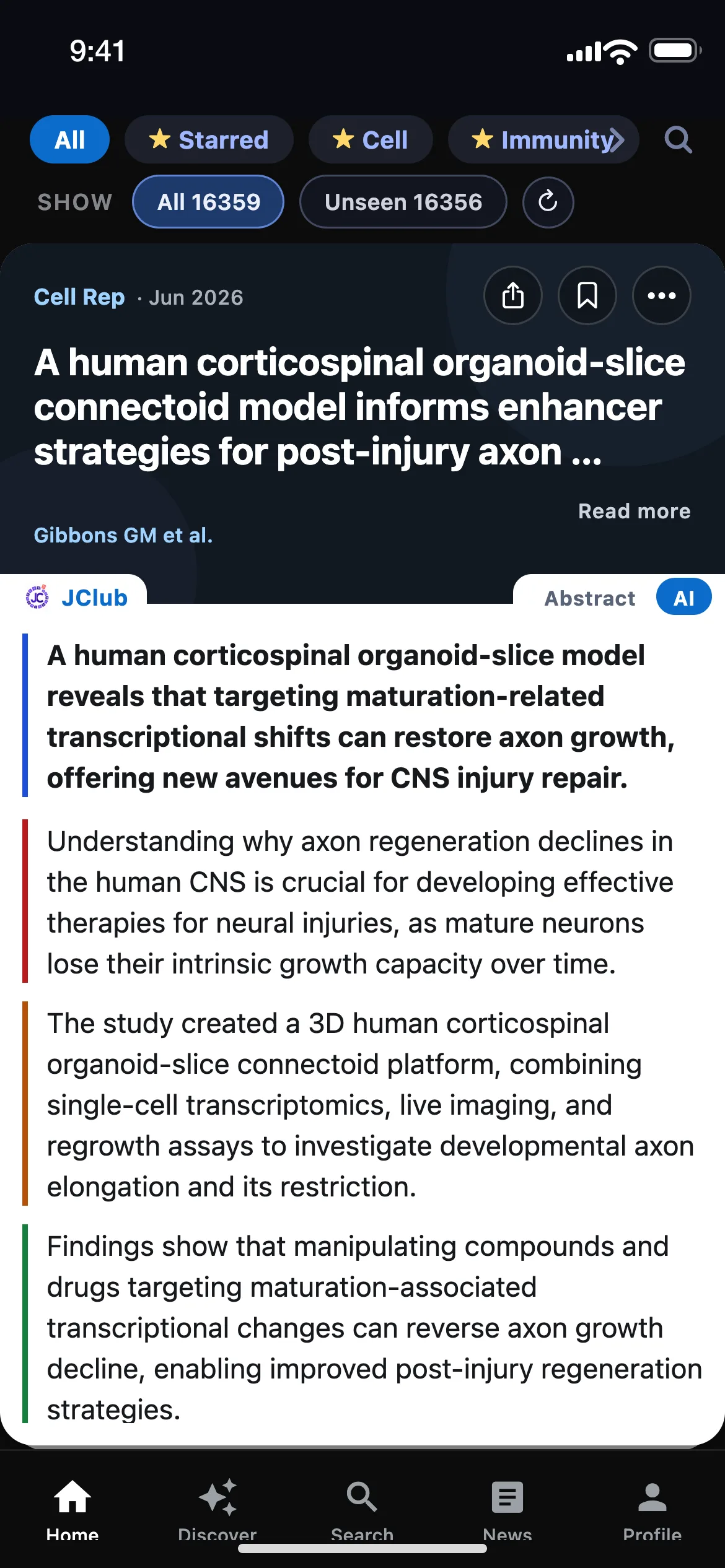
Every paper with an abstract opens with a four-part AI summary: the finding, why it matters, what they did, and the result — the headline marked in blue, the rest in reading order. The paper itself is one tap away — and the abstract too, where its licence allows.
AlphaFold predicts a protein's 3D structure from its sequence alone with near-experimental accuracy — a median backbone error of about 1 Å across the CASP14 blind assessment.
Every notification answers three questions at a glance: which paper, why you, why now. Citations to your work lead; keyword matches, followed authors and papers, and your digest follow — every kind is laid out in Tuned to you below.
JClub personalises on three things you set yourself — the interests you name, the papers you’ve published, and the journals and people you follow. Here they are, with the controls around them, drawn the way they look in the app.
Home is ranked inside the journals you track by the interests you name and, once you’ve connected ORCID, by your own publication record. Signed in, it also learns quietly from what you save, open and skip. One switch decides the balance.
Personalize Home by
Choose what shapes your Home feed. Publications only apply once you’ve connected your author profile.
Papers that match you always come before the rest, whichever mode you pick.
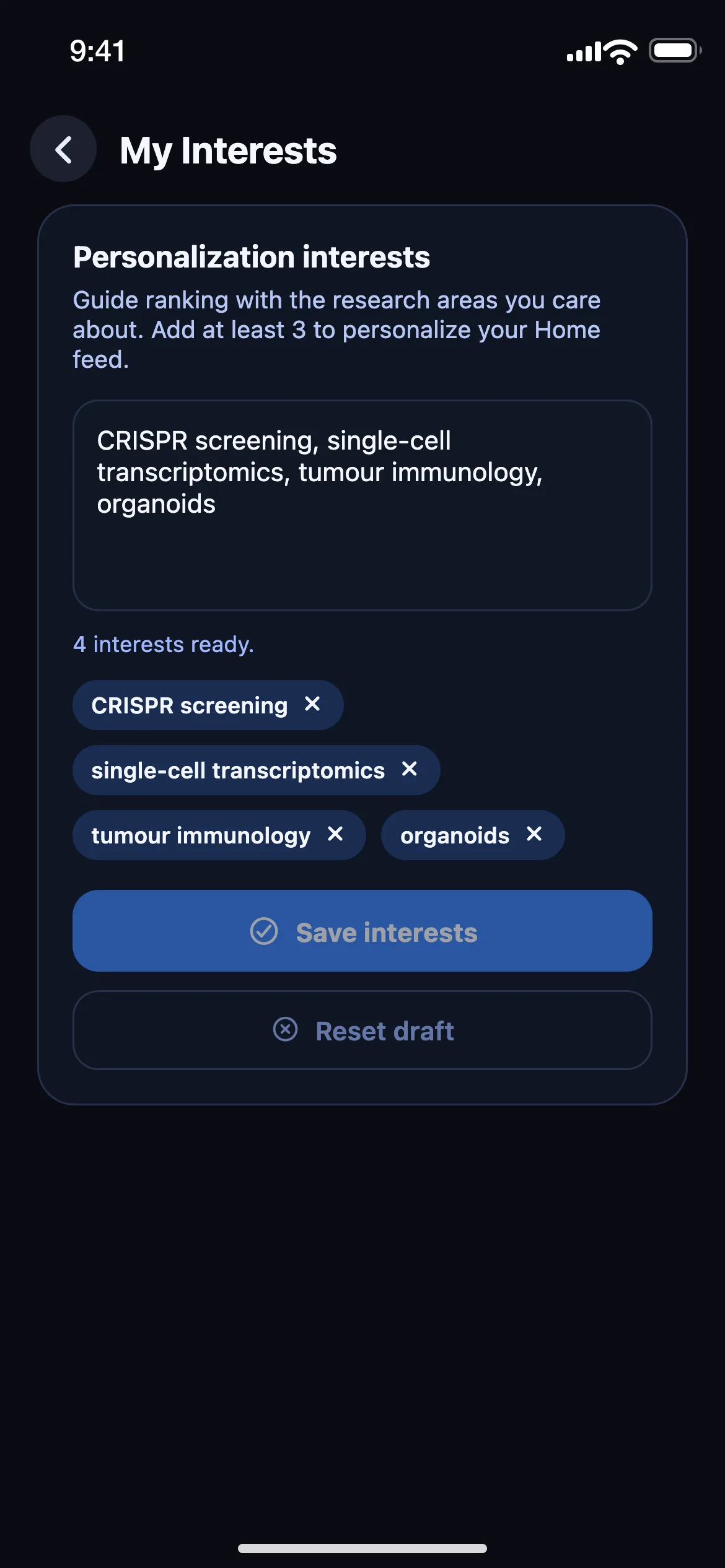
Name three or more interests and they shape Home, the Discover rails, News for you, search shortcuts and your digest — matched on topics, not just the literal word. Keyword filters are the strict cousin: only papers containing that exact term, DOI or trial ID reach the deck.
Each interest is matched on topics — see the ones moving this week →
Up to five alert keywords are checked against every new title and abstract — real-time, hourly or daily. Add citation alerts for your own papers and for any paper you follow, a push when a followed author publishes, and a note if a saved paper is retracted or a preprint you follow is published. Usually within a few hours of a paper appearing online.
The weekly digest leads with any new citations to your work — otherwise with your top interest — then your strongest match, its one-line finding and journal, with the rest a tap away. It holds one to five papers and skips a week rather than pad one. A daily digest is there if you want it.
Get a daily summary of new papers.
Get a weekly summary of top papers.
Star a journal and its newest papers become stories at the top of Discover. Follow an author for a rail of their newest work and a push when they publish — for profiles JClub can verify. Follow a paper to be told when it’s cited. Claim your institution for its newest papers in Discover.
Prefer papers with abstracts? One switch hides the rest. Motion is optional, so is the summary highlighting, and the daily science brief is one switch — on iOS it may start as a quiet trial you can turn off. No permission dialog at launch, only when you switch something on. Library access has its own switch once you’ve claimed your institution — where your library is on LibKey, JClub checks the holding before it promises full text — with an advanced field for a custom proxy.
Turn this off to keep abstract-missing articles out of the feed.
Disable swipe animations in the feed.
Mark the summary’s headline with a blue rail. Also toggleable on each card.
One notification each morning with the day’s biggest science stories. Works signed out.
Your library is on LibKey: JClub checks whether your library has each article, so a “Full text” label means it’s really there. You sign in on your library’s own page — JClub never sees your password.
Defaults shown — on iOS the science brief may start as a quiet trial; the switches here are a preview.
A one-paragraph morning read on the day’s biggest science stories, research news with our own brief and a link out, funding calls sorted by what closes next, meetings soonest-first by region, and research jobs with closing dates up front. Every For You rail says why: “Because you follow …”.
Home is what’s new in the journals you track, ranked for you. Discover is what that feed would miss — one question per rail, named in the title.
Technique-heavy papers worth scanning when you need a methods refresh.
Papers punching above field average by normalized citation impact (FWCI).
Long-horizon papers that still define the conversation. Filter by 1, 5, 10, or 20 years.
A one-year window has few true classics, so the app tops it up from High impact, Rising and New — this list does the same.
On this page the rails glide so you can see more of them. In the app you scroll each rail yourself and page it ten cards at a time.
Real papers from the app’s Discover rails, a snapshot taken 20 September 2026 · citation counts via Crossref · field percentiles via OpenAlex · titles link to doi.org. In the app the rails refresh hourly and rotate daily.
 Works with LibKey
Claim your institution once. Where your library is on LibKey — most Australian universities and around 1,800 libraries worldwide — JClub asks your library before it promises anything, so when a card says Full text, it’s really there.

LibKey is a trademark of Third Iron LLC.
Connect Zotero or Mendeley once, and every paper you save lands in a “JClub” collection or folder in your own library — ready in your reference manager when you sit down to write. Nothing to export, nothing to remember.
Zotero is a registered trademark of the Corporation for Digital Scholarship; Mendeley is a trademark of Elsevier. JClub is an independent app and is not affiliated with or endorsed by either.
One search across every paper JClub tracks — journals, preprints, and research news — ranked by relevance and recency.
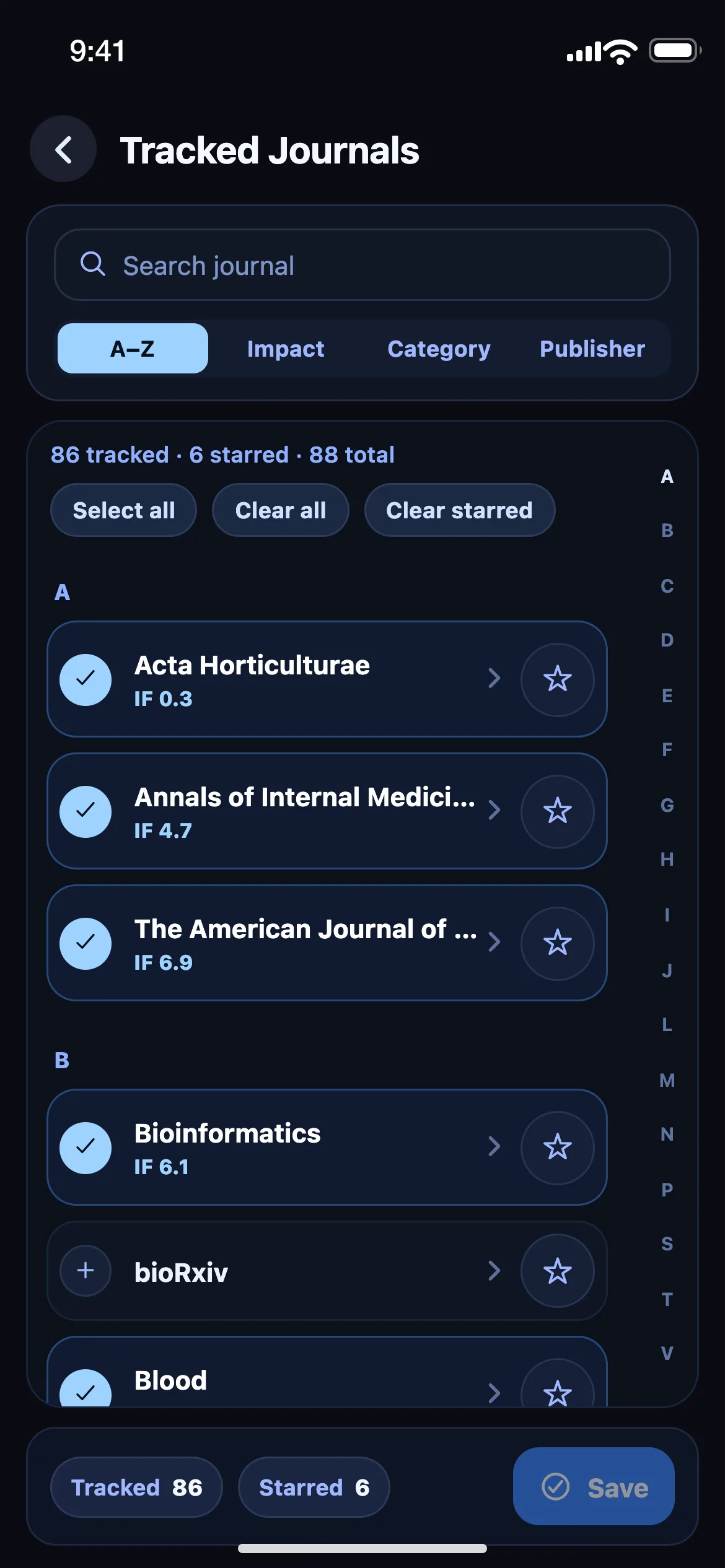
JClub tracks 104 journals across 10 fields and both preprint servers. Every journal has its own page — in the app, the list is My Journals.
Everything works without an account. Your choices stay on your device until you decide to sign in.
No data brokers, no tracking across apps, no third-party ad SDKs. Sponsored items, where they appear, are clearly labelled, sold by us directly, and never influence your ranking — advertisers get no data about you.
Every card links to the publisher or repository of record. AI summaries assist — they never replace the paper.
More detail in the privacy policy.
JClub is free on the App Store and Google Play, and you can start reading without an account.